

Carried by 1 nurseries
View Availability at NurseryData provided by the participants of the Consortium of California Herbaria
View additional distribution information on the Jepson eflora
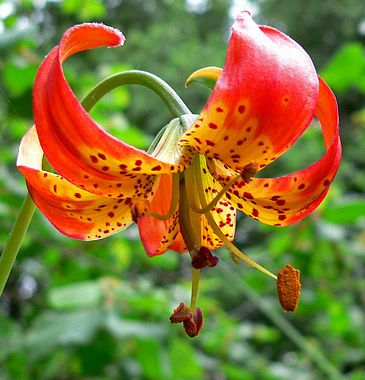
Lilium pardalinum subsp. pitkinense, the Pitkin Marsh lily, is an endangered perennial herb of the Liliaceae family that is endemic to certain wetland areas in the northern California Coast Ranges of Sonoma County, California, USA. It is a subspecies of Lilium pardalinum. Lilium pardalinum subsp. pitkinense is found in the narrow elevation range of 35-60 metres (115-197 ft) above mean sea level. The Pitkin Marsh lily is found only in freshwater marshes and wet meadows in western Sonoma County, Northern California. There are only three known colonies of this rare species in the vicinity, including the Pitkin Marsh situated near State Route 116 between Sebastopol and Forestville, California. ,. A land development proposal has been proposed which would infringe upon this marsh, which contains a second rare plant species, the white sedge, Carex albida. The historic range is thought to have been throughout a slightly wider portion of the wetlands of Sonoma County, with much higher densities of organisms, possibly ranging into the Laguna de Santa Rosa. Lilium pardalinum subsp. pitkinense attains a height of 1-2 metres (3. 3-6. 6 ft). The leaves of the Pitkin Marsh lily are typically about 14 centimeters long and one to two centimeters in width. The whorled leaves of the Pitkin Marsh lily are staggered along the stem, and are generally elliptical to oblanceolate in shape. Near the Pitkin Marsh, individuals are found which seem to be hybrids with the closely related Panther lily. The plant blooms in the months of June and July. Petals are red at their outer margins, transitioning to yellow at the centers, with small dark maroon dots. The anthers are purplish-brown. This species is distinguished from its more common lookalike, the Leopard lily (Lilium pardalinum), by shorter petals and anthers. Lilium pardalinum subsp. pitkinense attains a height of 1-2 metres (3. 3-6. 6 ft). The leaves of the Pitkin Marsh lily are typically about 14 centimeters long and one to two centimeters in width. The whorled leaves of the Pitkin Marsh lily are staggered along the stem, and are generally elliptical to oblanceolate in shape. Near the Pitkin Marsh, individuals are found which seem to be hybrids with the closely related Panther lily. The plant blooms in the months of June and July. Petals are red at their outer margins, transitioning to yellow at the centers, with small dark maroon dots. The anthers are purplish-brown. This species is distinguished from its more common lookalike, the Leopard lily (Lilium pardalinum), by shorter petals and anthers.
Perennial herb, Geophyte
3 - 7 ft Tall

Orange, Red, Yellow, Purple
Summer
Full Sun
Low, Moderate, Very Low
For propagating by seed: Sow outdoors in summer for germination the following spring, or 3-6 mos. warm then 2-3 mos. cold stratification. For forcing slightly green or fresh seeds: 6-8 wks. warm (70°F) stratification or until the majority of seeds have formed bulblets; then 4-6 wks. cold (about 35°FJ stratification; sow, and at 55 to 60°F leaves should be produced in 4-6 wks. (De Graaff 1951).
Moist places