

Carried by 87 nurseries
View Availability at NurseryData provided by the participants of the Consortium of California Herbaria
View additional distribution information on the Jepson eflora
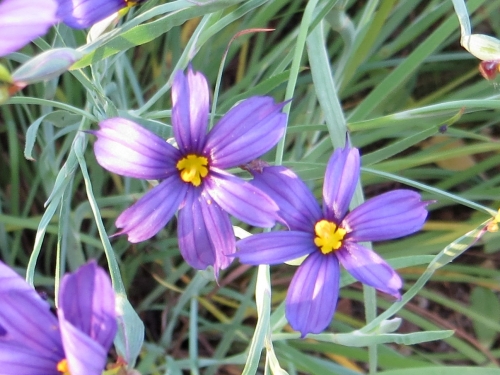
Blue-eyed Grass (Sisyrinchium bellum) is a 1-ft-tall perennial herb that grows throughout California, usually in open places where there is some moisture, particularly grassy areas. It can also be found in woodlands and at altitudes up to almost 8000 feet.
Its leaves are grassy and tufted. The flowers are small and purplish-blue, varying somewhat in color from a true blue to a definite purple; occasional white-flowering plants are found. It flowers from January to July. After flowering, it dies back to the ground and is dormant over the summer. It prefers some moisture and good drainage, but will tolerate summer dryness.
It can be propagated by seed, and self-sows. It can also be propagated by division of its rhizomes, and the flower stems can be rooted. It is moderately hardy and will tolerate temperatures down to 20 degrees F.
Blue-eyed Grass is very easy to grow and will easily reseed. Best to plant on flat areas in loamy soils that that hold moisture well.
Even though it goes dormant in the summer in dryer, southern areas, Blue-eyed Grass is more likely to survive the summer drought with occasional watering. It's best to plant this at the edges of landscapes for pops of color.
This plant is on several fire-resistant plant lists, including FireSafe Marin and County of San Diego.
Perennial herb, Geophyte
1 - 2 ft Tall
.3 - 1.5 ft Wide
Upright Columnar
Moderate
Summer Semi-deciduous
None

Blue, Purple, Lavender
Spring, Winter
Containers, Deer resistant, Groundcover, Lawn alternative
Full Sun, Partial Shade
Low
Max 2x / month once established
Easy
Tolerates cold to 0° F
Fast, Medium, Slow
Tolerant of sand and clay.
Soil PH: 5 . 0 - 8 . 0
Readily self-seeds. For propagating by seed: 1.5 mos. stratification. No treatment for 3-6 yr. old seeds.
3, 4, 5, 6*, 7*, 8, 9*, 10, 11, 14*, 15*, 16*, 17*, 18*, 19*, 20*, 21*, 22*, 23*, 24*
Meadows, seasonally moist Grasslands, grassy openings in Chaparral or Coastal Scrub, understory of Yellow Pine Forest and Foothill Woodland, and on the margins of wetland/riparian areas
Coastal Scrub, Foothill Woodland, Freshwater Marsh, Inland Closed-Cone Coniferous Forest, Lower Montane Coniferous Forest, Lowland Chaparral, Meadows, Montane Chaparral, Perennial Grassland--Remnant Non-desert Grassland, Riparian Woodland, Sagebrush
Chamise (Adenostoma fasciculatum var. fasciculatum), California Buckwheat (Eriogonum fasciculatum var. fasciculatum), Lemonade Berry (Rhus integrifolia), Ponderosa Pine (Pinus ponderosa), Box Elder (Acer negundo), Bigleaf Maple, Pacific Madrone (Arbutus menziesii), Manzanita species, Artemisia species, native grass species, Juncus spp., Allium spp.